New Shoe Materials of 2026: How to Care for Vegan Leather, Recycled Knit, and Bio Foam
The new shoe materials of 2026 — vegan leather, recycled knit, and bio foam — are replacing real leather and traditional rubber for environmental reasons. But each has its own properties and reacts differently to Saigon's hot, humid climate. Vegan leather peels in sheets under high humidity, recycled knit soaks up water fast, and bio foam breaks down sooner than traditional EVA. You can't treat these materials the way you'd treat real leather. If your vegan leather shoes are already peeling or your bio foam has collapsed, send photos for advice — recovery options are very different from leather's.
The new materials of 2026 and their properties
Vegan leather
- What it is: a PU or polymer coating over a fabric base — no animal hide involved.
- Risk in Saigon: high humidity makes the coating peel off in sheets, especially around the toe flex zone and heel.
- Signs of failure: peeling sheets, surface cracking, fading, hardening and brittleness.
- Recovery potential: limited — once it peels, it's very hard to restore the original surface.
Recycled knit
- What it is: recycled polyester fibers (from plastic bottles) woven into a one-piece upper.
- Risk in Saigon: absorbs water quickly, yellows in sunlight, snags if scrubbed hard.
- Signs of failure: yellowing, pilling, small holes, musty odor.
- Recovery potential: decent — gentle cleaning and stain treatment usually work.
Bio foam
- What it is: foam made from bio-based feedstock that degrades faster than traditional EVA.
- Risk in Saigon: absorbs moisture quickly, collapses early, crumbles if stored long in a damp closet.
- Signs of failure: flattened cushioning, surface cracks, crumbling under thumb pressure.
- Recovery potential: limited — collapsed foam never regains its cushioning; you need new insoles or new shoes.
Care table by material
| Material | Safe cleaning | Risks if done wrong | Recovery potential |
|---|---|---|---|
| Vegan leather | Light damp wipe, never soak | Peeling, cracking, brittleness | Limited |
| Recycled knit | Soft brush, diluted soap | Snagged fibers, yellowing | Decent |
| Bio foam | Damp wipe, no soaking, no heat drying | Collapse, crumbling, cracking | Limited |
| Gore-Tex (hybrid) | Lukewarm water, neutral soap | Loses waterproofing | Good if done right |
Common DIY mistakes with new materials
- Using real-leather care on vegan leather: leather conditioner lifts the PU coating right off.
- Machine-washing recycled knit: the spin cycle snags fibers and warps the shoe's shape.
- Soaking bio foam in water: the foam absorbs water, collapses, and crumbles faster.
- Using alcohol or harsh solvents: they destroy the vegan leather coating and the Gore-Tex membrane.
- Drying in harsh sunlight: fades knit, embrittles vegan leather, and cracks bio foam.
- Storing in a sealed, damp box: bio foam crumbles, vegan leather peels, knit molds.
How to store each material correctly
Vegan leather
- Wipe with a soft damp cloth — no soaking, no leather conditioner.
- Avoid sharp creasing at the toe and heel, where the coating cracks along fold lines.
- Store somewhere airy and dry — humidity accelerates coating peeling.
- Never use mink oil or beef-tallow conditioners — their chemistry reacts with PU.
Recycled knit
- Clean with a soft brush and diluted soap; never wring or twist.
- Air-dry naturally in a breezy spot — never in harsh sun.
- Stuff with absorbent paper when storing, to hold shape and vent moisture.
- Apply a knit-specific waterproofing spray if the shoe has no protective layer yet.
Bio foam
- Wipe lightly with a damp cloth — no soaking, no high-heat drying.
- Inspect regularly if stored long-term — bio foam breaks down faster than EVA.
- Replace the insoles if the foam collapses, to restore the underfoot feel.
- Never store in a damp environment — bio foam absorbs moisture and degrades quickly.
DIY or professional?
| Situation | DIY | Send photos for advice | Visit EXTRIM |
|---|---|---|---|
| Light dirt on knit | Yes | ||
| Light peeling on vegan leather | Recommended | ||
| Large-area peeling on vegan leather | Recommended | ||
| Collapsed or crumbling bio foam | Recommended | ||
| Small holes in knit | Recommended | ||
| Musty odor or mold on knit | Recommended |
How EXTRIM processes new materials
Step 1: Identify the exact material. Distinguishing vegan leather, real leather, knit, and bio foam determines the right process.
Step 2: Assess the damage. Peeling, cracking, collapse, or tearing — each requires different treatment.
Step 3: Clean by material. Material-appropriate solutions and techniques, patch-tested on a hidden spot first.
Step 4: Treat the specific fault. Peeling vegan leather, stained knit, collapsed bio foam — each has its own treatment path.
Step 5: Protect and finish. A material-appropriate protective layer to slow future wear.
Step 6: QC and handover. Recovery limits clearly stated, especially for peeling vegan leather and collapsed bio foam.
How EXTRIM assesses condition
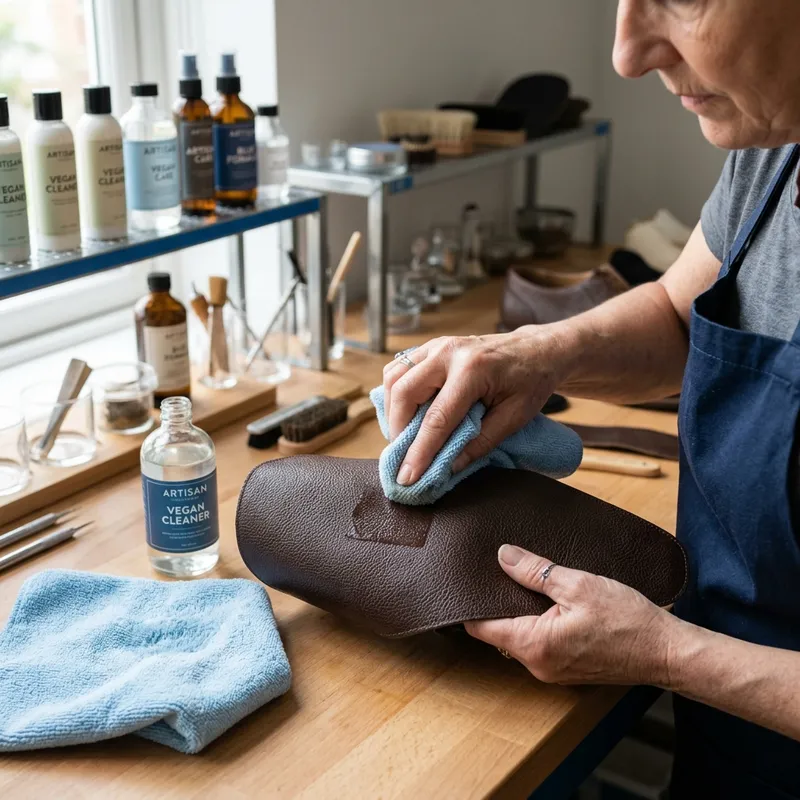
With new materials and multi-layer constructions, each pair needs individual inspection rather than a one-size-fits-all formula. If a before–after case file is cleared for use, the article will state the case ID and shooting conditions; stock photos are no substitute for a real assessment.
Costs and sensible choices
The cost of treating new materials depends on the material type, the damage, and what's recoverable. Vegan leather with large-area peeling may never fully recover, and should be discussed carefully before treatment. Lightly soiled knit cleans at low cost. Collapsed bio foam usually can't recover its cushioning — plan on new insoles or new shoes.
See also: our shoe cleaning service in Ho Chi Minh City, the Adidas Samba/Gazelle suede dark-edge guide, and cleaning HOKA, Salomon, ASICS, NB.
FAQ
Is vegan leather as durable as real leather?
No — it's less durable in hot, humid climates. The PU coating peels in sheets after prolonged moisture exposure, while real leather can partially self-recover with proper conditioning.
Can recycled knit go in the washing machine?
Not recommended. The spin cycle snags fibers and warps the shoe. Hand-wash with a soft brush and diluted soap instead.
Can collapsed bio foam be fixed?
No. Collapsed foam never regains its original cushioning. New insoles can improve the underfoot feel, but a collapsed midsole is a sign it's time for new shoes.
Can I use leather conditioner on vegan leather?
No. Leather conditioners contain oils that react with the PU coating, causing peeling and discoloration. Use products made specifically for synthetic leather.
Should new-material shoes get a nano coating?
Depends on the material. Knit takes waterproofing nano coatings well, but vegan leather needs its own specialized formula. Get advice per material — don't use a universal coating.
How often should I clean new-material shoes?
Every 2–4 weeks depending on wear frequency and how dirty they get. Vegan leather needs more frequent gentle wiping to prevent trapped moisture from causing peeling.
If your new-material shoes are peeling, stained, or collapsed, send EXTRIM 2–3 clear photos of the damage via Zalo so a technician can identify the material and recommend the right fix, or book a treatment in Ho Chi Minh City.
Edited by the EXTRIM content team and technically reviewed by the technician in charge of new shoe materials.
Public case file
This article is not linked to any before–after case file cleared for publication. The content describes general guidance and service categories; results, timing, and the degree of improvement depend on the actual condition of each pair.
Need Professional Attention for Your Item?
EXTRIM provides two-way doorstep courier pickup across Ho Chi Minh City, with up to 80,000 VND off qualifying orders. Service options, final pricing, timing, and any applicable repair warranty are confirmed for each item.