How to Clean Suede Leather Shoes Properly — Without Stiffening the Nap
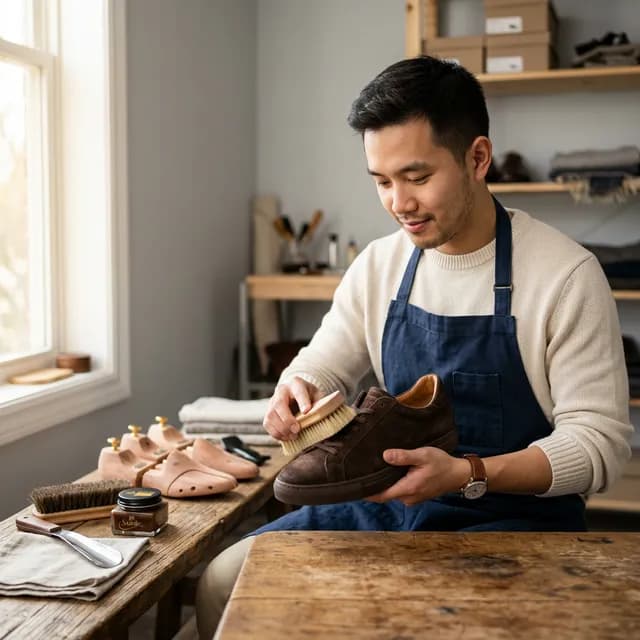
Suede's short-fiber surface holds dust, water, and oil far more readily than smooth leather. So cleaning should always start dry — and always be spot-tested in a hidden area. The goal isn't to soak the whole shoe, but to lift dirt with just enough moisture and just enough pressure.
How are suede and nubuck different?
The two look very similar. Suede is sanded on the flesh side of the hide, while nubuck is sanded on the grain side — nubuck's fibers are shorter and finer, making it slightly more durable. Both attract dust and absorb water faster than smooth leather, so they need more regular brushing and protection.
Identify before you clean
Some pairs are natural suede, some are nubuck, some are faux-suede materials — each with a different finish. Check the label, examine the cross-section if you can, and test products on the tongue or inner edge first.
If the surface is already widely faded, has oil blotches, deep-set mold, or dye transfer from another item, don't start with soaking or hard scrubbing. These conditions need assessing first — wetting them can spread the stains further.
Three gentle home-cleaning steps
Step 1: Dry brush
Let the shoes dry completely, then use a suede brush with light, multi-directional strokes to lift dust out of the fibers. Go easy on folded edges and already-thin areas.
Step 2: Spot-treat marks
For small dry marks, use a suede eraser or a suitable tool with short, gentle strokes. Stop and check the color after each pass instead of scrubbing until the surface shines.
Step 3: Controlled product use
For dirt that won't lift dry, use a product explicitly made for suede. Work up foam on the brush or cloth, patch-test on a hidden area, then treat one small section at a time. A dry cloth should only blot — never swipe sideways, which mats the nap.
Let the shoes air-dry naturally in a ventilated spot. No direct heat, and never store them while still damp inside.
The minimal tool set
Four items cover home care: a suede/nubuck brush, a stain eraser, a foaming cleaner made for suede, and a waterproofing spray. No big investment needed — what matters is using the right tool for the right step and testing on a hidden area first.
Reapply protection regularly
Once the shoes are fully dry, spray a suede/nubuck waterproofing product from about 30 cm away, roughly every three months — more often in the rainy season. A protective layer keeps new stains from setting in; prevention is always easier than restoration.
What to avoid
- Soaking the whole shoe in water when you don't know the structure or finish.
- Harsh soap, bleach, or stiff brushes.
- Scrubbing the same spot over and over trying to erase a set-in stain.
- Drying in harsh sun or with a hot dryer.
- Spraying waterproofing products without testing a hidden area first.
When should you hand them to a technician?
Stop home treatment if the oil stains are spreading, mold keeps returning, color is blotching, the nap has matted into patches, or the surface shows cracking. Blood, grease, paint, or deep-set mold stains rarely come out completely at home — hard scrubbing only spreads them further. A technician needs to identify the material, how deep the problem goes, and the restorability before choosing a cleaning, conditioning, or recoloring approach; EXTRIM's suede spa starts at 200,000 VND per pair (2026 reference).
How does EXTRIM assess a pair of suede shoes?
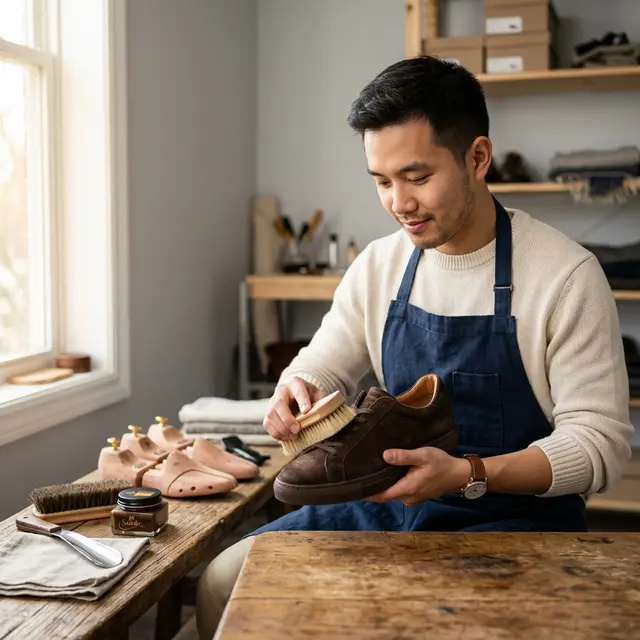
Before accepting a job, the technician examines the material, the dirt level, discolored areas, and the glue and structure. The method may include dry cleaning, spot treatment, re-fluffing the nap, or color adjustment — not every pair suits the same process.
EXTRIM states upfront what can be improved and what can't be guaranteed. Result photos are only meaningful under the same lighting and the same material condition.
👉 Send photos of your suede shoes for an EXTRIM assessment
Public case studies
Photos in this article illustrate the process — they are not a before–after record with a public case code. EXTRIM does not use illustrative images to promise results for every pair.
Need Professional Attention for Your Item?
EXTRIM provides two-way doorstep courier pickup across Ho Chi Minh City, with up to 80,000 VND off qualifying orders. Service options, final pricing, timing, and any applicable repair warranty are confirmed for each item.