5 Signs Your Leather Shoes Need a Resole — a 2-Minute Check

A good pair of leather shoes is built to be resoled many times — the upper can last decades with proper care, and the sole is the consumable part meant to be replaced on schedule. The problem: most owners only notice once the damage has climbed into the upper, when repairs cost several times more. The five signs below take two minutes to check.
1. The sole feels soft and mushy under thumb pressure
Press your thumb into the middle of the outsole. A healthy leather sole is firm, slightly rigid, and carries the shoe's weight. If it feels soft and the dent does not spring back, the outer layer has worn through. A soft sole also loses its water resistance — moisture travels from the sole into the shoe's interior faster than you would expect.
2. Holes or deep craters on the sole surface
A hole is not just a cosmetic issue. Humid air and water seep between the outsole and midsole, keeping the inner lining damp until the welt separates from the sole. See a deep crater or a hole — resole now, before the next rainy season.
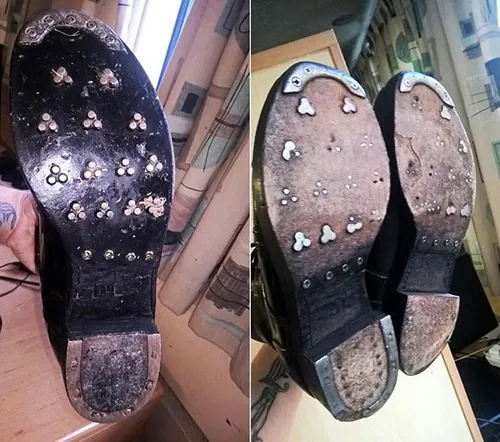
3. The sole edge is worn down to the welt stitching
Turn the shoe sideways and inspect the edge where the sole meets the upper. On welted shoes, once the edge wears deep enough, the stitching that holds the welt to the upper becomes exposed. From that point every step grinds the thread — wear through the welt and you face a full re-welt, far more expensive than a resole. Catching it at this sign is the cheapest stop.
4. The tread is worn flat and slick
The teeth and tread pattern are where grip comes from. When the sole is polished flat, shoes slip on wet floors — this shows first at the toe and the inner heel, where you place the most weight. Light localized wear can be handled with a half-sole Vibram patch on one position; a full resole is not always needed yet.
5. Wide delamination and an aged, brittle sole
A small glue lift at the edge can be reglued or stitched. But when the sole separates from the upper across a wide area, or an old sole has gone hard and brittle, spot repairs last only weeks — removing the old sole and fitting a new one is the correct repair, and saves you from repeating this in a few months.
Why you should not resole at home
- Picking the right sole size and hardness per shoe takes experience; the wrong sole changes your gait.
- Removing the old sole incorrectly tears the midsole or the welt — damage that cannot be undone.
- Gluing or stitching a sole needs even clamp pressure and proper adhesives; household glue lasts weeks at best.
One-sided wear also signals a gait or fitting problem — read more in why your shoe soles wear unevenly on one side.
Resoling at EXTRIM: reference rates 2026
- Full sole replacement (standard): 550,000 VND, done in 7–14 days.
- Full sole replacement (custom-ordered soles): 1,000,000–2,000,000 VND, 25–30 days.
- Heel cap replacement (dress shoes/heels): 250,000 VND, 5–7 days.
- Sole protection (Vibram): 599,000 VND — a technician reviews photos to pick the right coverage for localized wear.
- Vibram full-sole application: 599,000 VND — protects an original leather sole from wear.
See details on our sole protection service; upper damage alongside it is handled through shoe repair. If the shoes are still new and the sole barely worn, protecting it early costs less than a late resole — see the standard for proper Vibram sole application and how it compares with stitched (welted) soles.
👉 Send photos of your soles for a condition assessment
Public Cases
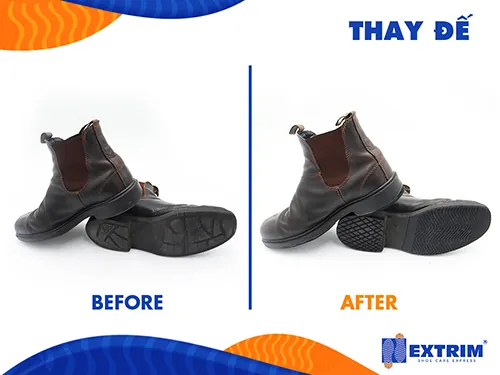
Photos in this article illustrate the process — they are not a before–after record with a public case code. EXTRIM does not use illustrative images to promise results for every pair.
Need Professional Attention for Your Item?
EXTRIM provides two-way doorstep courier pickup across Ho Chi Minh City, with up to 80,000 VND off qualifying orders. Service options, final pricing, timing, and any applicable repair warranty are confirmed for each item.